


The Texas legislature passed House Bill 8 on Oct. 23, 2025, changing the policy for standardized testing throughout the state. Written by Representative Brad Buckley, this bill repeals traditional STAAR tests for the 2027-28 school year, opting for adaptive testing, removal of the English II test and the implementation of beginning-of-year, middle-of-year and end-of-year assessments.
“Over time, testing became too high-stakes, too disruptive to instruction and not timely enough to actually help students in understanding where there may be educational gaps,” Representative Buckley said. “The bill is about refocusing Texas’ assessment and accountability system on supporting learning in addition to measuring it.”
For third through eighth grade, all beginning-of-year, middle-of-year and end-of-year assessments will be required. Once in high school, the district may choose whether to administer the beginning-of-year and middle-of-year assessments.
“The goal of HB 8 is to make ‘testing day’ just another day at school,” Representative Buckley said. “The intent is to create a less stressful testing environment by setting expectations clearly, reassuring students and emphasizing that assessments are tools for learning, not judgments of worth or ability.”
House Bill 8 also bans the administering of Benchmark testing in an attempt to limit the amount of school days spent taking standardized testing. The adaptive testing will be reminiscent of MAP testing, allowing students to track their growth in particular subject areas throughout the year. 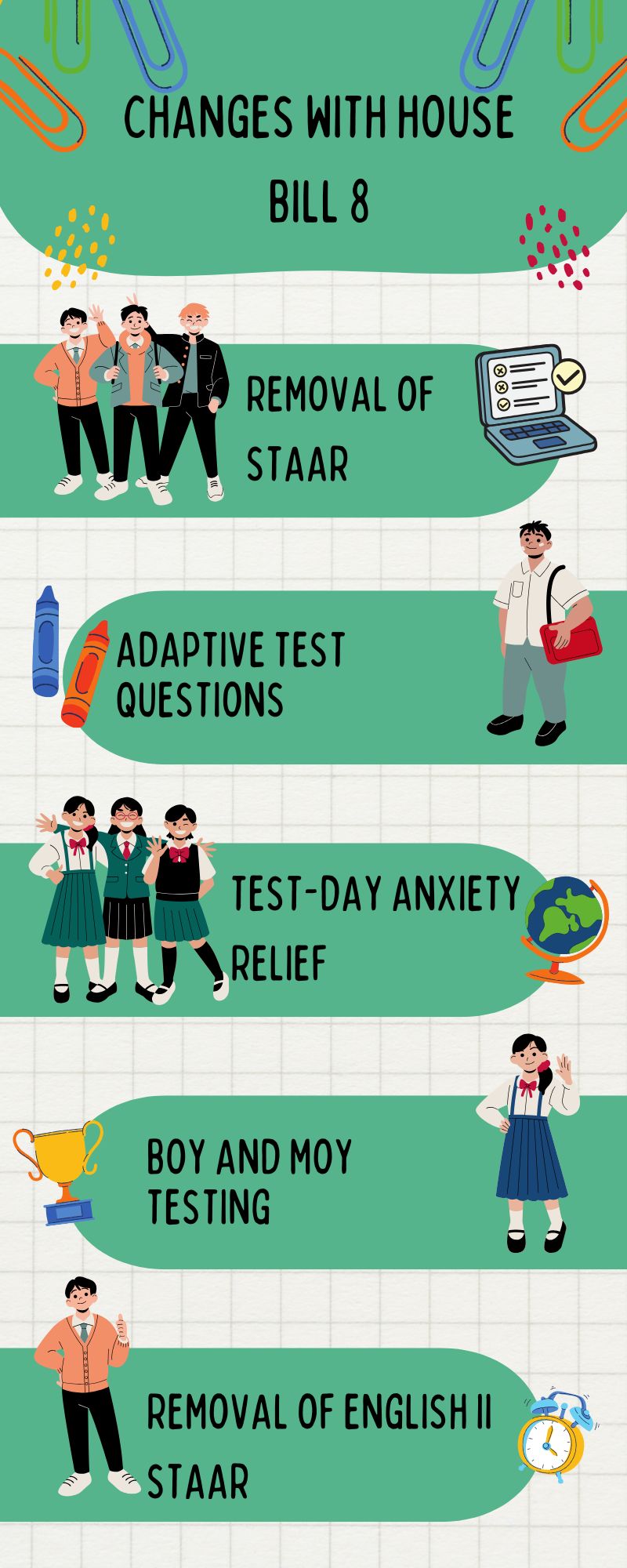
“Adaptive tests are a useful tool because they can better pinpoint where a student is academically and adjust in real time,” Representative Buckley said. “The downside to adaptive tests is that due to the large volume of questions needed, it is impossible to release all the questions every year for parents and students to see which ones they missed.”
To begin the transition away from STAAR testing, several changes will be added for the 2026-27 school year, including allowing Monday tests, easier access to results and the administration of the last STAAR tests.
“As with any major policy shift, the biggest risks are implementation challenges – technology readiness, educator training and maintaining comparability across districts,” Representative Buckley said. “That’s why legislative oversight and phased implementation are critical.”
These changes will also impact teachers, such as English teacher Alix Allender, by causing shifts in how students get prepared.
“I think it’s great to individually meet students where they are to challenge individuals and allow them to demonstrate their learning and growth,” Ms. Allender said. “I fear that some may try to manipulate the system rather than test with integrity.”
Though issues with adaptive and standardized testing remain, teachers feel that this bill brings new opportunities for the further education of students.
“I am hopeful that, without an EOC, Advanced English II classes can cater to and challenge students on track to complete AP or TCC English courses junior and senior year,” Ms. Allender said. “I would also hope that there can be specific on-level classes structured to bridge gaps for students who are behind or did not meet state requirements by passing the English I EOC.”
The adaptive tests will also be shorter than the previous STAAR tests.
“I think the shorter assessments will help ease some students with testing anxiety, but it also does require students to be assessed more frequently,” Ms. Allender said. “I personally believe that students are already over-tested.”
The addition of assessments to the school year means that, along with mid-term and final exams for courses, PSAT testing and the TSI, students will be expected to take more exams than in previous years.
“I’ve been in districts where we gave some kind of adaptive test,” Dr. Stephanie Bonneau, principal, said. “When you have an adaptive test, as a teacher or as a campus leader, I have a better idea for where your learning actually is right now so that we can adjust what your instruction looks like. [We can] get you caught up if we need to or accelerate because we see that you’re ahead of where you should be.”
Students, parents and staff often criticize the use of standardized testing as a measure of academic readiness.
“I believe the spirit behind standardized testing comes from a good place,” Dr. Bonneau said. “It’s a way to ensure everybody is getting an equitable education because you have at least these standards that we know you can meet.”
Once implemented, biology, Algebra I, English I and U.S. History will all be part of the high school testing. Of the four exams, three will be taken during students’ freshman year.
“I would have preferred to get rid of the freshman test and keep the sophomore test,” Dr. Bonneau said. “That gives students a little longer to acclimate to high-school-level writing and reading, and it separates them from biology and Algebra I because those are generally taken freshman year.”
The funding of public schools and school districts relies on the results of standardized testing, causing a push for high performance from students. This causes students and staff alike to feel anxiety. To help this, House Bill 8 also addresses test-day anxiety by providing on-screen instructions for students to reference while taking exams.
“The hard part with standardized testing is we are judging districts and campuses by student performance on one day,” Dr. Bonneau said. “There’s so much cumulative work that goes into preparing a student for the next grade that you don’t see reflected on a test. It causes a lot of stress and distress in students and faculty members, too.”
Those who worked to create House Bill 8, such as Representative Buckley, said these changes will benefit Texas students.
“While not particularly popular, standardized tests have an important role, but they should be limited, purposeful, and instructionally relevant,” Representative Buckley said. “Standardized tests can be helpful as a tool to understand how well all Texas students are doing compared to their peers nationally so that we can provide support where needed.”
