

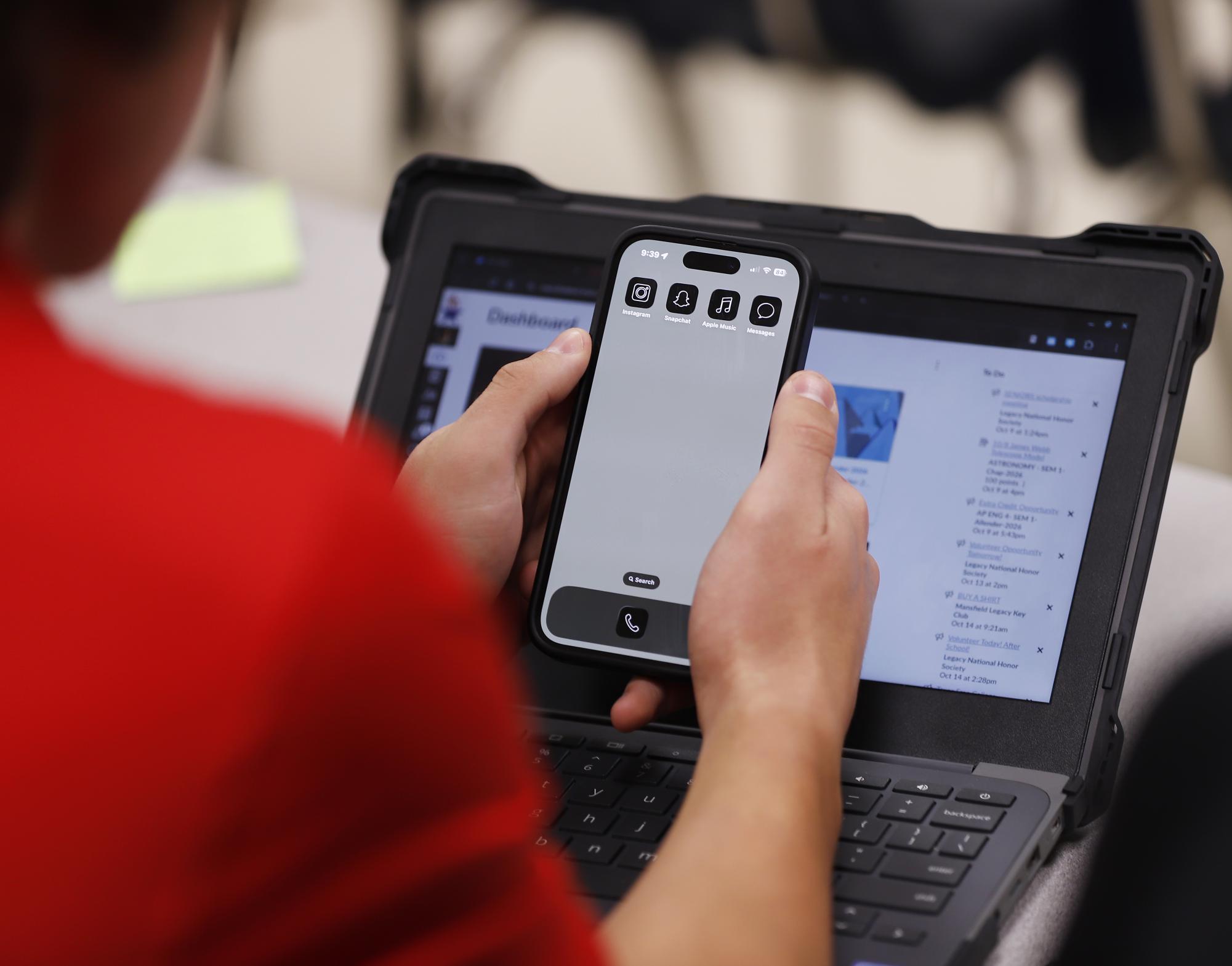

After House Bill 1481 signed into law on June 20, 2025, by Gov. Greg Abbott, students can no longer use any personal communication devices during the school day. Texas Representative Caroline Fairly primarily wrote the bill.
“Phone-free schools give students the chance to fully engage in their education and in each other,” Rep. Fairly said. “When we reduce the constant pull of notifications and social media, classrooms become calmer, more focused and more connected. Teachers can teach without competing with screens, and students have the space to think, create and build real relationships.”
The bill was introduced on Dec. 2, 2024. It passed through the Texas House with 136 yeas and 10 nays at the second reading on April 23, 2025, and 128 yeas and 17 nays at the third reading on April 24, 2025. On May 25, 2025, the bill passed the Texas Senate with 31 yeas and zero nays to be effective for the 2025-26 school year. Principal Stephanie Bonneau facilitated the change at Legacy, where personal devices are banned from 7:25 a.m. to 2:55 p.m.
“I see a lot more student interaction,” Dr. Bonneau said. “The cafeteria is a lot louder than it has been in the past, in a positive way. Students are talking to each other more because they aren’t on their phones or using noise-cancelling headphones.”
Because students cannot use personal computers anymore, students who never checked out a district-issued Chromebook had to get one this year.
“It’s caused some frustration in getting things settled for some students because it takes time to get all the Chromebooks checked out,” Dr. Bonneau said.
Teachers and administrators carry around device-collection forms that ask for student names and ID numbers. When a student’s phone gets taken up, they put it in an envelope with the form attached to the outside, so the student can pick it up from the bookkeeper at the end of the day.
In the first three days of school, the administration collected around 20 phones out of about 2,300 students. However, in the weeks following, the number ticked up to around 20 per day.
“It’s funny because I thought we would get more at the beginning and then it would kind of taper down, but I had it in reverse,” Dr. Bonneau said. “It’s been ticking up as students get comfortable on campus and start trying to push boundaries more, but I imagine it will go back down again because the consequences are pretty sturdy.”
For a first offense, students get lunch detention. For the second, they get one day of AC, which means they lose the ability to exempt their finals at the end of the semester. The number of AC days increases by offense, from three days to ten days until the fifth offense, which gives the student 30 days in the Disciplinary Alternative Education Program (DAEP).
“For the students I’ve taken phones from, it really was an accident, like out of habit,” Dr. Bonneau said. “But we haven’t had a problem with students being defiant or argumentative about giving their phone over, and the process has gone smoothly as far as pickup.”
Staff adapts to students not being able to use their phones educationally. On the first day of school, each student received a paper copy of their schedule since they could no longer check their phone for their room number. Paper forms are now available for students who need a Verification of Enrollment (VOE) to get their driver’s license or permit but can no longer scan the QR code.
“It’s stuff that you just don’t think about,” Dr. Bonneau said. “I think we didn’t realize how dependent we were on QR codes and the ability to take pictures of things until we really started digging into what ‘no phones’ really means.”
Some classes suffered because of the lack of personal communication devices. Junior Cannon Clary experienced some of those struggles in the past couple of months.
“In some classes, it really limits us as to what we can do,” Clary said. “I’m in technical theater, so we use our phones and personal Chromebooks or MacBooks to design our lights and sound, but we can’t do that anymore because of the bill.”
Not only does the bill include phones and personal computers, but it also includes smartwatches like Apple watches.
“My main worry is like if there’s something important that my mom needs to text me about,” Clary said. “I’m not getting my phone out, I can just look at the message on my watch really quickly. I guess she could just call the school and tell me that way, but the school takes forever to do that.”
Despite some of the drawbacks of the bill, Clary appreciates how the lack of phones affected his fellow students.
“There’s less zombies in the cafeteria now, which is definitely a positive effect,” Clary said. “I also feel like more people are paying attention.”
Students and staff continue to adjust to the new policies as it works its way into their new normal for school days.
“I feel like after COVID and the rise of phones, learning communication skills like making eye contact, leaning forward and gesturing fell to the wayside partially,” Dr. Bonneau said. “My hope is that students get more comfortable talking to one another. I can see it happening a little bit already.”

