With Artificial Intelligence, or AI, becoming more accessible than ever before, barriers begin to pop up and the strings that tie people together begin to loosen. Authentic bonds become less valuable as AI takes the place of empathetic conversations between humans. While AI can benefit and damage people and their relationships, conflicting feelings cause controversy and ultimately a split between people on whether or not they support AI.
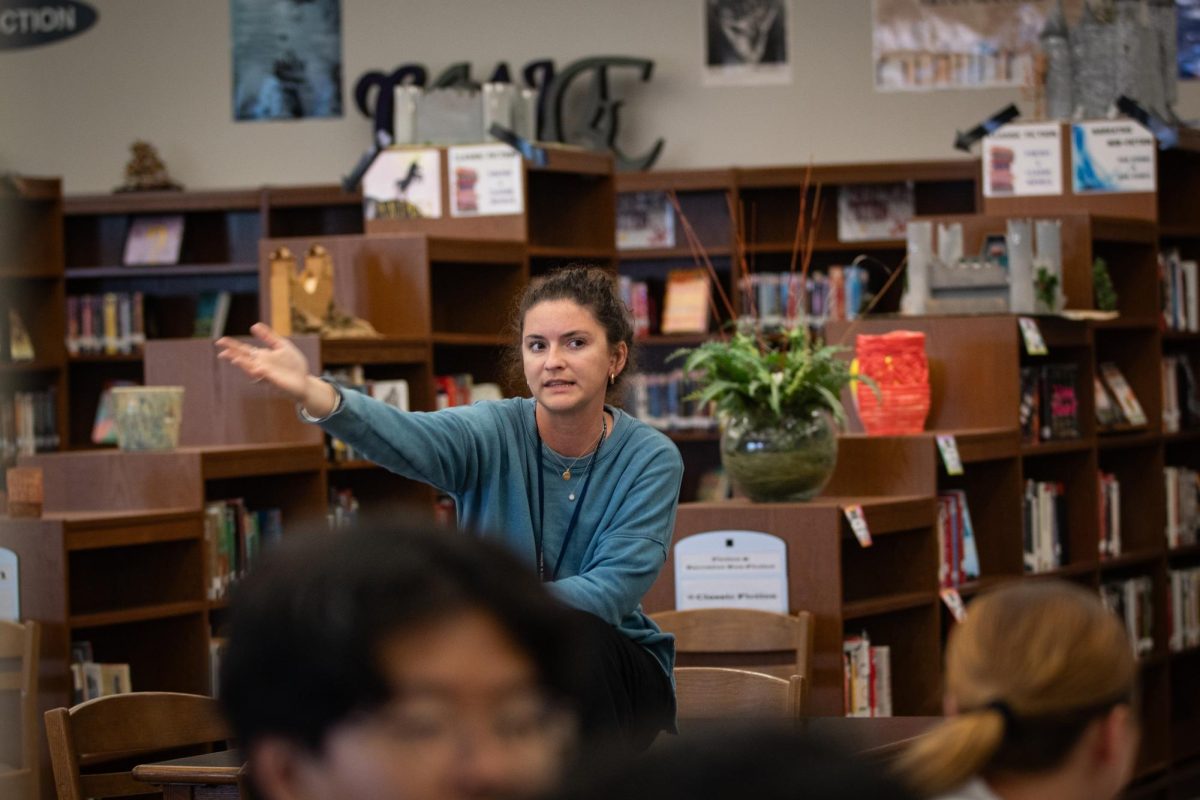
“I think that AI is dangerous. It can further remove people’s empathy in a time that empathy is oftentimes forgotten,” Advanced English II teacher Mackenzie Blank said. “I also think that it could lead to a decline in people’s interpersonal skills — something a lot of teens already lack due to living so much of their lives behind a screen — and encourage isolation.”
AI establishes a way where people can access information and help without an authentic human connection. While using AI saves time for people who need help in the moment, it can damage the relationships between people by establishing a reliance on AI instead of encouraging communication from actual people.
According to family studies, 71% of young Americans feel uncomfortable with AI relationships, while the remaining 29% have mixed feelings or already participate in AI relationships.
“There are aspects of a conversation and interaction that are lost when you are using an AI versus a real person, such as empathy and expression, flexibility and creativity, and nuanced understanding of lived experiences,” Ms. Blank said. “I think the more people use AI, the less they will remember or care what those aspects are. Eventually, they will be lost or seen as inconsequential.”
In schools, AI becomes an issue when students use it in place of their own work. This limits what they learn because they rely on AI to complete their assignments rather than learning the content themselves, creating a setback in their learning. Between January and May of 2025, the usage of Ai jumped up 5%.
Plagiarism, an act of academic dishonesty in which a person steals someone else’s work and passes it off as their own, connects back to AI in school because it uses formerly established resources to answer questions a person asks. For teachers, this adds to the list of what they must monitor when grading student assignments.
“It is very easy for kids and teens to be lured by the ease of using AI without noticing and caring about the long-term consequences of never learning how to do things for themselves or understanding the content they are supposed to be learning,” Ms. Blank said. “Having to always be vigilant about whether or not my students are using AI just adds one more thing I have to try to monitor instead of focusing on actually helping them improve their writing.”
AI’s accessibility becomes prominent in class work and can create a gap of suspicion between students and teachers. In turn, this impacts the bonds created between them and can affect student learning when there is a lack of trust to conform to one another, further damaging the flow of communication between students and teachers.
“I would say that AI has negatively impacted my relationships with students,” Ms. Blank said. “In my opinion, it has led to distrust between students and teachers.”
Alongside building subject-specific skills, school teaches students how to hone their communication skills by incorporating lessons centered around conversation while also learning the curriculum. But with AI now holding more prominence, students don’t benefit from learning new vocabulary or conversational skills in the long run because they can access AI for assistance with personal matters rather than using their own minds to process information.
“I do think [AI] does make conversations difficult. A great thing about embracing conversations with peers is building listening, processing, and communication skills,” AP Language and Composition teacher Alexandra Kim said. “When humans become too reliant on an external brain to complete those processes for them, it prevents them from developing their mind.”
According to the Higher Education Policy Institute, or HEPI, student use of AI jumped from 66% to 92% between 2024 and 2025.
College Board, a website used to help students prepare for college, states that more than 85% of school administrators view AI as an asset that can assist in student learning. However, schools still have concerns about the use of AI and how it can deteriorate education.
“As a fairly young teacher, I am not opposed to the internet as a positive tool in the classroom; in fact, I have relied on it many times in the past,” Ms. Kim said. “However, in an English classroom where AI is often used by students to complete assignments in place of their own work, it becomes an extremely frustrating challenge.”
As for work in class, ChatGPT, a common AI-powered tool that students use that answers their questions in depth within seconds, gained popularity among a wide range of high school students to do their work for them or help them with their homework. As of recently, teens who use ChatGPT alone for their schoolwork grew from 13% to 26%, doubling the number of users since 2023, according to Pew Research Center.
“AI can have a positive influence in the classroom, especially if used for the right reasons. As a teacher, my goal is to ensure all of my students are learning material,” Ms. Kim said, “and when the effort becomes that of the computer instead of the mind of a student, there is learning lost. It is when it is used in place of someone’s own thinking that it becomes a hindrance.”
While AI can help people in the moment, it does not benefit them in the long run. AI does not foster the skills that students need to be successful in the future, reducing the vocabulary of students because they rely heavily on an existential tool to complete their thinking for them.
Junior Vivienne Kerley said the issue is having a negative impact on human development.
“I don’t think it makes us very successful and I do not find it positive for humans and our cognitive development. It limits our vocabulary, especially when it comes to conversing online or writing,” Kerley said. “You can say when writing essays, you’re very limited on vocabulary because you find the easy way out, and you benefit from AI coming up with stronger words when you could just do that yourself by picking up a dictionary.”
Passion, empathy, kindness and patience are emotions that AI does not present when used as a communicator for people. Unlike authentic human connections, AI cannot provide emotional input on a subject, making it unreliable for issues circulating one’s personal life.
“It can really just make you regress in social skills and communication skills, especially when you’re talking online, and all you’ve been doing is talking to fake people from AI. AI comes with very simple, non-complex answers for you, and they’re structured in a way for humans to understand quickly,” Kerley said. “You know, very simple, but when you’re talking to an actual human being, they’re more in-depth. They show more emotion. They can be more passionate, and it can be very hard for some people like that.”
The world constantly changes, especially with the presence of AI. People use it more and more in their daily lives and become less and less prone to using their own thinking skills in conversations. Limiting the use of AI when communicating with others would benefit the growth of comprehension skills used in conversations; however, it proves quite difficult as anyone has access to AI.
“I think there are a lot of potential uses for it that could make people’s lives a lot easier,” Ms. Blank said. “However, I am not sure that it is worth giving up all the other things that AI might erase or the other problems it may cause.”